When businesses assess energy efficiency, attention often goes to major energy-consuming equipment such as heating, cooling, compressed air and production systems. However, the performance of the building itself can have a significant influence on how much energy those systems need to use.
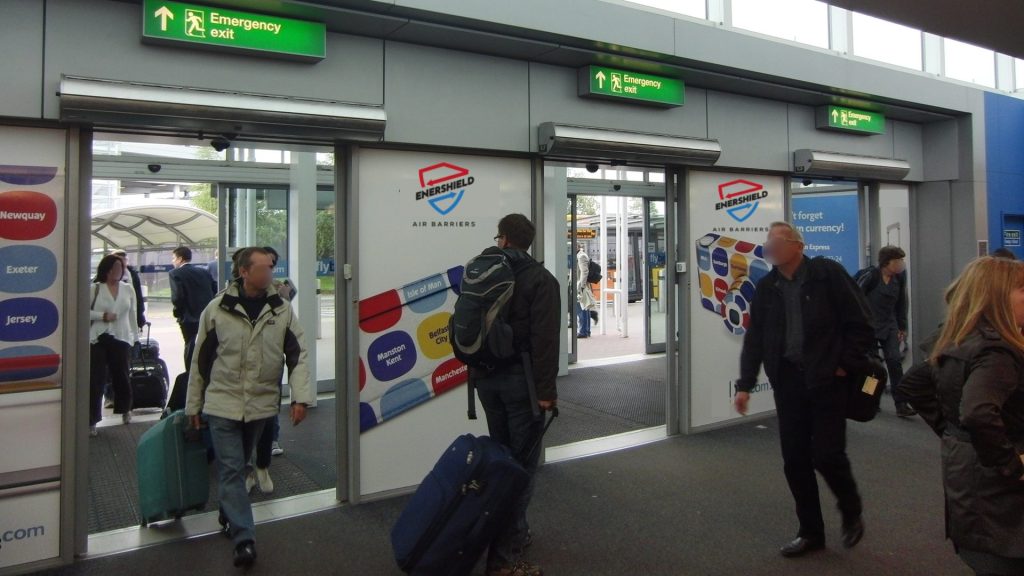
Industrial doorways are one example. In warehouses, manufacturing facilities, distribution centres and temperature-controlled environments, large doors can open frequently throughout the working day. Every time a doorway opens, the separation between the internal and external environment is temporarily removed, allowing air to move between the two spaces.
The question is whether that movement is significant enough to affect overall building performance.
What happens when an industrial door opens?
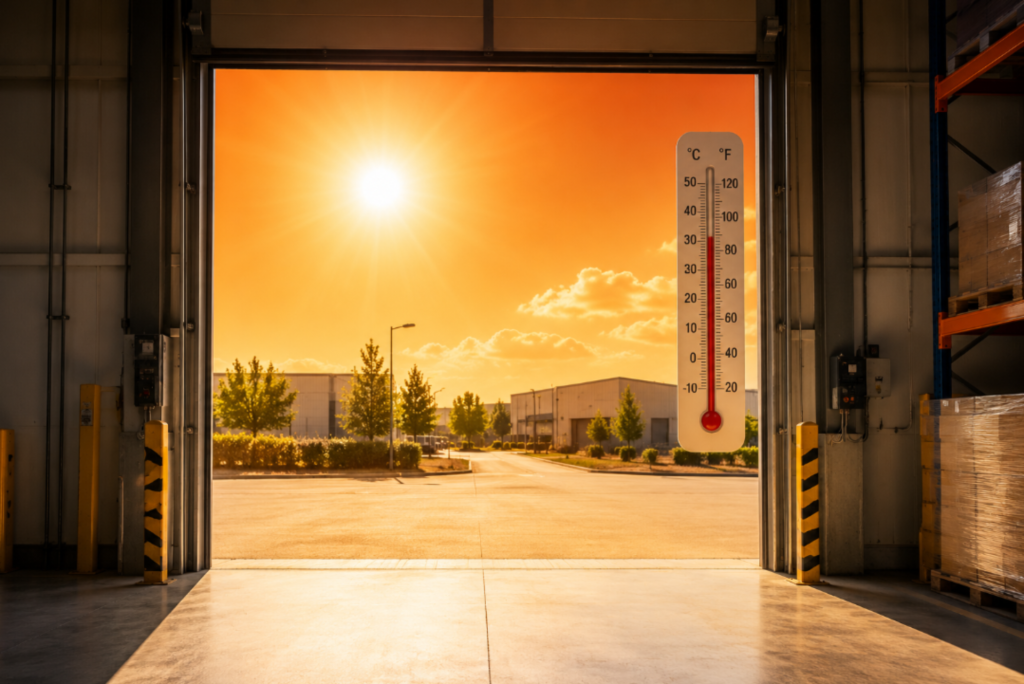
Air movement through an open doorway is influenced by several factors, including the difference between internal and external temperatures, pressure differences, wind conditions, the size and height of the opening and how long the door remains open.
Where there is a significant temperature difference, differences in air density can cause warm and cold air to move through the opening simultaneously. Wind and building pressure can increase this exchange further.
This uncontrolled movement of air is known as infiltration. For a conditioned building, infiltration introduces an additional load that the heating or cooling system has to manage.
For example, if a facility is heated to maintain a consistent internal temperature during winter, colder external air entering through a doorway has to be heated. At the same time, conditioned warm air leaving the building represents energy that has already been used but is no longer contributing to the internal environment.
One opening may have a relatively small effect. If the same entrance opens repeatedly across an eight, twelve or twenty-four-hour operating period, however, the cumulative impact can become much more significant.
The impact extends beyond the doorway
Air infiltration does not only affect the immediate entrance area. Repeated changes in internal temperature can increase heating or cooling demand as the HVAC system works to return the space to its required conditions.
The scale of this additional demand will vary considerably between applications. Door dimensions, opening frequency, external temperature, wind exposure, internal temperature requirements and building layout all affect performance. This is why simply knowing that a building has a large industrial door is not enough to determine how much energy is being lost.
It is also important to consider the application. A frequently used loading bay operating throughout winter will have different requirements from an occasionally opened warehouse entrance. Similarly, a refrigerated or temperature-controlled facility may be more sensitive to infiltration because maintaining stable internal conditions is fundamental to the process.
There can also be secondary effects. External air may introduce moisture, dust, fumes or insects into a facility, while temperature fluctuations around entrances can affect working conditions for employees positioned nearby.
Managing infiltration without restricting access
Keeping a physical door closed would reduce air exchange, but this is not always operationally practical. Industrial entrances exist to allow the movement of people, vehicles, materials and equipment, and some facilities require almost continuous access during busy periods.
The more useful question is therefore how air infiltration can be reduced while the entrance remains operational.
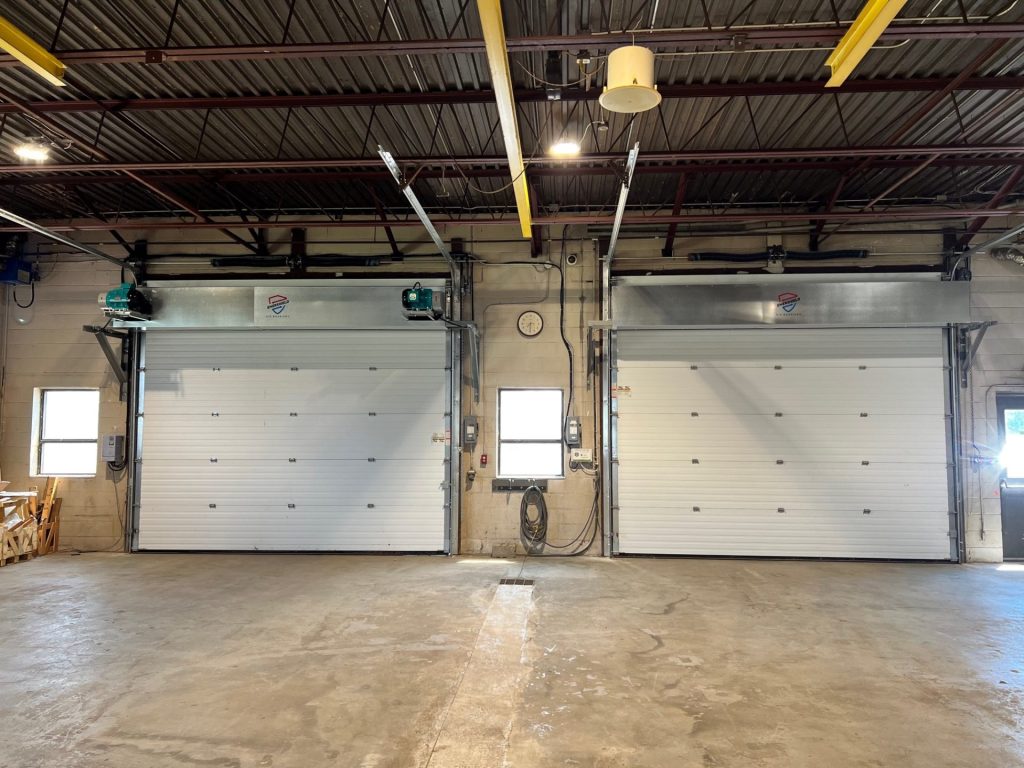
Different approaches can be appropriate depending on the application. These can include reducing unnecessary door-open time, using automated or fast-action doors, improving controls and using technologies such as Enershield Air Barriers.
An air barrier creates a controlled stream of air across an open doorway. When correctly designed and applied, this air stream helps resist the movement of air between two environments while allowing the physical entrance to remain open. Its effectiveness depends on factors such as doorway dimensions, pressure conditions, temperature differences, equipment selection and installation.
This is why the performance of an entrance should be considered as a system rather than focusing on an individual product or component.
Measuring the difference
For businesses working towards energy and carbon reduction targets, identifying an inefficient entrance is only part of the process. The next step is understanding its actual impact.
This can involve assessing operating hours, door opening frequency, internal and external temperatures, airflow conditions and the energy required to maintain the desired indoor environment. Depending on the facility, HVAC energy consumption and temperature stability can also provide useful indicators of performance.
Establishing these conditions creates a baseline against which improvements can be assessed. It also allows businesses to prioritise measures based on evidence rather than assuming that every entrance will provide the same opportunity for energy reduction.
This is particularly important when sustainability projects need to demonstrate measurable results. A change that reduces uncontrolled air infiltration may also reduce the amount of heating or cooling required to maintain internal conditions, but the scale of that benefit depends on the specific application.
So, how much difference can one doorway make?
There is no standard figure because no two entrances operate under exactly the same conditions. A doorway that opens occasionally may have relatively little influence on overall energy demand, while a large, frequently used entrance separating significantly different environments can represent a much greater source of uncontrolled air exchange.
For businesses assessing building efficiency, the important point is not to assume that a doorway is either significant or insignificant. It is to understand how the entrance operates, measure the conditions around it and identify whether controlling air infiltration could reduce unnecessary HVAC demand.
Sometimes improving energy efficiency starts with understanding where conditioned air is going.