Airports are designed to keep people moving. Every day, thousands of passengers, staff, contractors and suppliers pass through terminal entrances, creating a constant flow between the indoor and outdoor environment. It is a sign of a busy, well-functioning airport, but it also creates one of the biggest yet often overlooked challenges for building performance.
Every time an entrance door opens, conditioned or heated air escapes, outside air enters and the carefully controlled environment inside the terminal begins to change. The cumulative impact of door openings over the course of a day, a month or a year can have significant consequences for energy efficiency, passenger comfort and indoor air quality.
As airports continue investing in sustainability and operational excellence, it is worth asking an important question. Are terminal doorways quietly becoming one of the biggest sources of energy loss?
The Busiest Entrances Are Also the Most Challenging
Unlike many commercial buildings, airport entrances rarely experience quiet periods. Automatic doors can open multiple times every day as passengers arrive, depart and move between transport links and terminal facilities.
This constant movement makes it extremely difficult to maintain stable indoor conditions. Every door cycle creates an opportunity for outside air to enter while heated or cooled air escapes, forcing heating and cooling systems to continually compensate for the changing environment.
During colder months, warm indoor air is replaced by cold external air. During warmer weather, hot outdoor air enters the terminal, increasing cooling demand. Wind conditions and pressure differences between the inside and outside of the building can further increase the amount of uncontrolled airflow through these doorways.
More Than Just Energy Is Lost
When people think about open doorways, energy loss is often the first thing that comes to mind. However, the exchange of air brings with it a range of additional operational challenges.
Outside air can carry humidity, dust, vehicle exhaust fumes, airborne particulates, and other contaminants into the terminal. From planes waiting on the apron to taxis idling at drop off and pick up points, airports can experience a large amount of external exhaust fumes. These factors can affect indoor air quality and place additional demands on HVAC systems that are already working hard to maintain a comfortable environment.
For airports welcoming millions of passengers every year, maintaining clean, comfortable indoor spaces is about far more than energy efficiency. It is an important part of the overall passenger experience and supports a healthier environment for both travellers and the staff who spend long periods working near entrances, security checkpoints and check-in areas.
Small Air Changes Create Big Operational Costs
The impact of frequent air infiltration has varying degrees of visibility, but it can be measured in several ways. While increases and decreases in temperature are immediately noticeable, things like pollution are often harder to notice and the damage can be done quietly in the background.
Heating and cooling systems must operate for longer to replace lost heated or conditioned air. Temperature fluctuations near entrances can reduce comfort for passengers and employees. Increased equipment runtime may also contribute to higher maintenance requirements and greater energy consumption over time.
When multiplied across multiple entrances operating almost continuously throughout the day, these seemingly minor losses can become a significant operational consideration.
As airports seek to improve efficiency without disrupting passenger flow, reducing unnecessary air exchange can make an important contribution to overall building performance.
Sustainability Starts at the Building Envelope
Across the aviation industry, airports are making significant investments in reducing carbon emissions and improving energy efficiency. Modern HVAC systems, renewable technologies and smarter building controls are helping operators move towards ambitious sustainability targets.
However, the performance of these systems depends on how effectively the building maintains its controlled environment.
If large volumes of heated or cooled air are continually escaping through busy entrances, even the most efficient HVAC equipment must work harder than necessary to maintain internal conditions.
Managing Airflow Without Restricting Passenger Movement
Airport entrances must remain open, accessible and efficient. Restricting the movement of passengers, luggage trolleys and accessibility equipment is never an option.
Instead, many airports are exploring ways to better manage the movement of air through open doorways while also looking to improve passenger throughput.
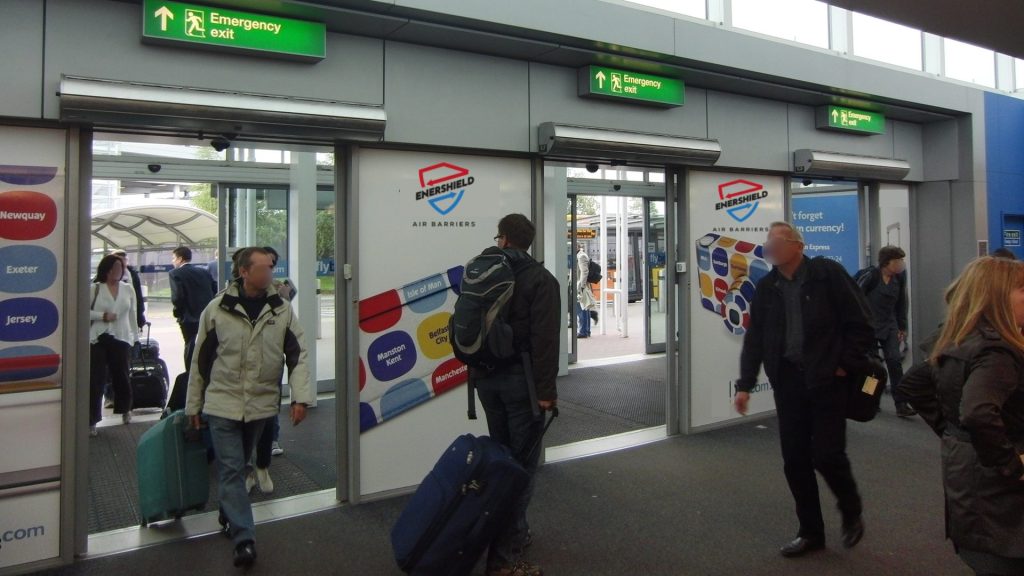
Enershield Air Barriers create a controlled stream of air across an open doorway, helping to reduce the exchange of indoor and outdoor air while allowing entrances to remain fully open and accessible. By reducing uncontrolled airflow, airports can improve passenger comfort, increase throughput of people, help maintain indoor air quality and reduce the workload placed on heating and cooling systems without interrupting daily operations.
Looking Beyond Traditional Energy Saving Measures
When discussing energy efficiency, attention often focuses on heating systems, cooling equipment or lighting upgrades. Yet one of the most influential factors in overall building performance can be found at the point where the indoor and outdoor environments meet.
Airport entrances are essential to the smooth operation of every terminal, but they also represent one of the largest opportunities to reduce unnecessary energy loss, improve indoor environmental quality and support long-term sustainability objectives.
As airports continue to modernise their facilities, it may be time to give as much attention to what happens at the doorway as to what happens inside the building itself.